
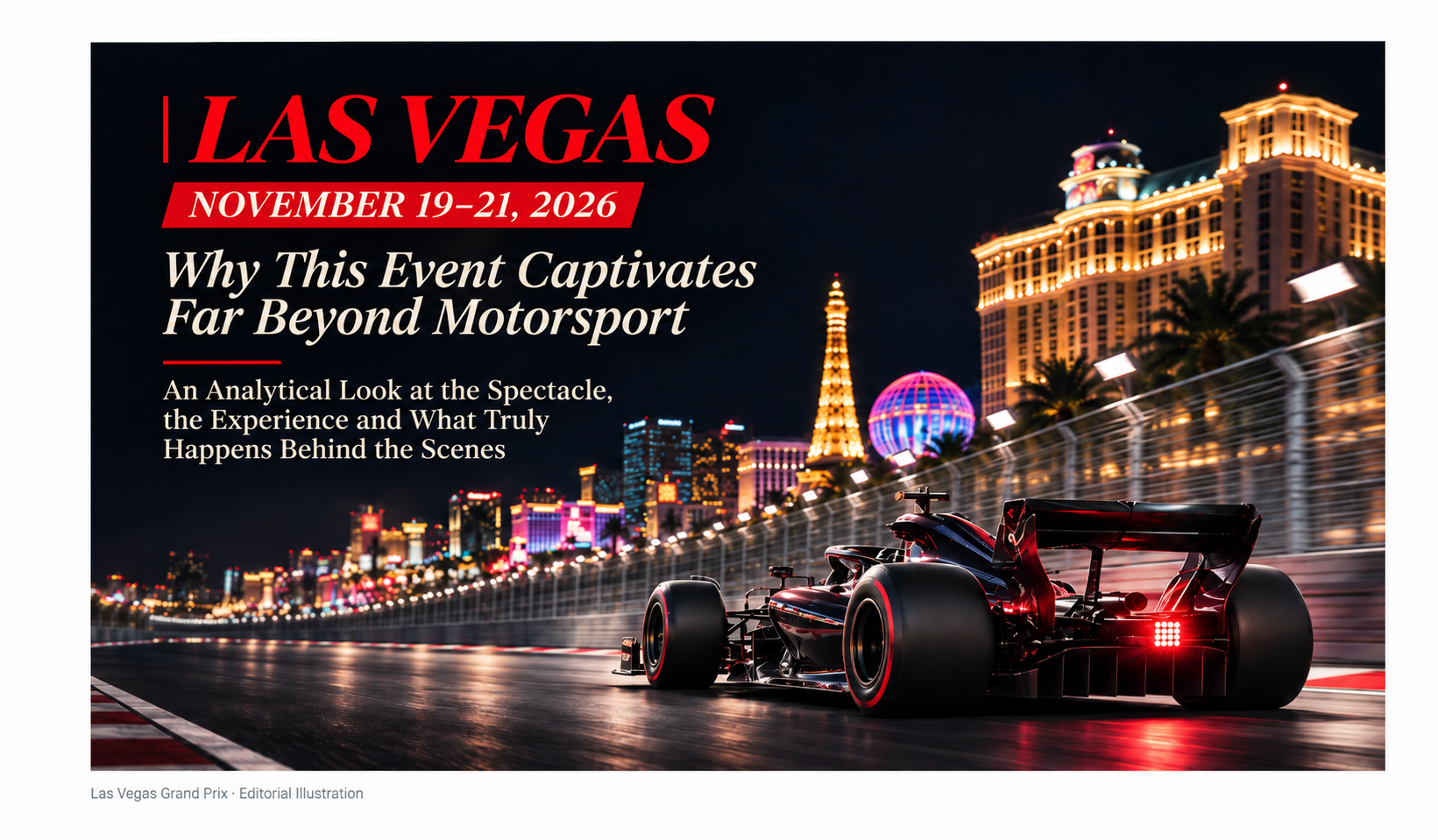
Saturday, November 21. Las Vegas, 8 p.m. Twenty-two Formula 1 cars will set off beneath the neon lights of the Strip for fifty laps. At such speeds, a driver cannot wait until every possible piece of data becomes available before making a decision. How do subjective perception, experience and objective information come together to support sound decisions? And what might this way of reasoning teach us about medical situations that remain insufficiently explained?
I Drive My Cases
When a complex medical file reaches my desk, I do not regard it as a static collection of documents. I seek to reconstruct its trajectory: what happened, which decisions were made, what information supported them, and what has changed since.
Like a driver approaching a corner, I must first identify where the reasoning needs to slow down. Should a symptom be placed within a different chronology? Does an earlier investigation contain information that has never been considered alongside subsequent findings?
The apex then represents that particular detail capable of changing the interpretation of the entire situation. It does not necessarily involve a spectacular discovery. Sometimes, it simply leads to a different question, one that is better grounded and more useful to the physician.
Finally comes the exit: the formulation of an actionable analytical direction, without turning a hypothesis into a diagnostic conclusion.
The comparison obviously has its limitations. A patient is not a car, and a physician is not a race engineer. Nevertheless, it helps illuminate a shared requirement: to make sound decisions, one must know where to direct one’s attention.
A Lap of Las Vegas, from Inside the Cockpit
The Las Vegas street circuit measures 6.201 kilometres and features seventeen corners. Its layout runs along the Strip, close to some of the city’s most recognisable hotels and landmarks.
On a circuit where Formula 1 cars can exceed 350 km/h, decisions follow one another at extraordinary speed. Tyre temperature, the road surface and the proximity of barriers constantly affect the margins available.
The driver’s body itself becomes an instrument of perception. Longitudinal and lateral acceleration, vibrations, pressure on the controls and resistance through the steering wheel transmit information that must be interpreted within moments.
Sensors record a multitude of parameters. Yet at the braking point, the driver must combine that knowledge with what is immediately perceived about grip and the behaviour of the car.
Las Vegas adds another distinctive dimension: the race takes place at night, under temperature conditions and biological rhythms that demand specific preparation.
The spectacle is visual, but performance calls upon the full range of perceptual and cognitive abilities.
What Makes Formula 1 Unique
A driver never comes into direct contact with the racing surface. Unlike a runner who can feel the ground beneath their feet, the driver perceives the track through an extraordinarily sophisticated machine.
This indirect form of perception requires the interpretation of information received through the seat, controls, acceleration and movements of the car.
Grip changes. Tyre temperatures fluctuate. Mechanical demands vary from one corner to the next, and a racing line that was effective only minutes earlier may become less appropriate.
The technical regulations introduced in 2026 also place greater emphasis on energy management and the adaptation of established driving habits.
Furthermore, the driver is never truly alone. Behind each decision stands an organisation comprising engineers, mechanics, performance specialists and professionals from numerous disciplines.
This collective intelligence, capable of processing enormous quantities of information, is one of the most fascinating dimensions of the sport.
The Tension Between Driver Feedback and Telemetry
A modern Formula 1 car produces an extraordinary quantity of data. Every session makes it possible to observe mechanical and dynamic parameters with remarkable precision.
One might assume that such measuring capabilities make the driver’s feedback less important. Yet personal experience remains an essential element of the dialogue with engineers.
Adrian Newey has notably emphasised the importance of the sensations described by drivers, including observations that do not immediately correspond to the available models.
Subjective perception is not automatic proof. A sensation may be inaccurate, influenced by expectations or by progressive adaptation to a problem.
Nevertheless, it can be investigated. Circumstances can be clarified, variations identified, observations compared, and the driver’s account examined alongside objective measurements.
This is the approach that interests me: not systematically opposing measured information to reported experience, but seeking to understand what a discrepancy between the two may actually mean.
The Patient and Their Own Debriefing
In certain complex medical situations, symptoms persist even though the available examinations do not provide a sufficiently coherent explanation.
This does not necessarily mean that a disease has been missed. Nor does it mean that the patient’s experience is without value.
Medical tests have indications, diagnostic performance characteristics and limitations. The clinical narrative also carries its own uncertainties.
A rigorous investigation consists precisely of examining both sources of information methodically.
Revisiting the chronology, clarifying a symptom, comparing different periods and identifying missing elements can help reformulate the questions addressed to the healthcare professionals concerned.
Choosing Your Risk, Seeing the Wall
In motor racing, danger has an immediate physical reality. The wall, braking distance, speed and available space make the consequences of an error particularly visible.
The evolution of safety equipment also demonstrates that risk is never regarded as definitively controlled. Knowledge must continually be reassessed in light of accidents and technological innovation.
In medicine, certain risks take a much slower and less visible form. Their consequences may emerge only after several years.
Making those risks understandable can help inform health decisions. Yet it would be reductive to attribute the difficulties patients encounter simply to a lack of willpower.
Physical, psychological, economic and social constraints must also be considered.
The lesson, therefore, is not to turn patients into competitors, but to reflect on how abstract information can become a concrete, understandable question capable of supporting a medical discussion.
The Racing Driver’s Brain: A Field Still to Be Explored
Research involving racing drivers examines attention, visual anticipation, learned automatisms and adaptation to perceptual constraints.
Some observations suggest that expert drivers are distinguished not only by reaction speed, but also by their ability to identify relevant information earlier.
Gaze strategies, blink patterns and the anticipation of changes in trajectory constitute particularly interesting fields of investigation.
Caution remains essential. Some available studies rely on small participant samples or experimental settings that do not fully reproduce Grand Prix conditions.
Nevertheless, the regulatory changes introduced in 2026 provide a fascinating context: highly trained athletes must reconsider habits and automatic responses developed over many years.
How does an expert brain recognise that certain strategies need to change? How does it distinguish a temporary error from a rule that is no longer appropriate?
At a conceptual level, these questions echo those surrounding human adaptation to new circumstances. They do not, however, demonstrate an equivalence between racing performance and medical care.
When Formula 1 Has Already Inspired Medicine
Certain connections between motor racing and medicine go well beyond an intellectual comparison.
In London, teams at Great Ormond Street Hospital for Children examined the organisation of Formula 1 pit stops as a way of improving patient transfers from the operating theatre to intensive care.
The principles examined included the allocation of responsibilities, the sequencing of interventions, the transmission of information and collective coordination.
The work published by Catchpole and colleagues in 2007 illustrates this effort to improve procedures in an environment carrying a high level of responsibility.
Technologies originating in motorsport data analysis have also been explored for monitoring certain hospitalised patients.
This does not suggest that medicine should operate like a Formula 1 team. Rather, it recognises that some organisations have developed methods whose underlying principles may stimulate useful reflection in other fields.
A Spectacle Just as Compelling on Screen as in Person
Formula 1 is often associated with the prestige of the paddock, exclusive hospitality and restricted-access environments. Yet this image does not encompass the experiences of its spectators.
Watching from a screen gives viewers access to camera angles, data, commentary and radio exchanges that allow them to follow racing strategies in particularly close detail.
Experiencing a race in person brings a different sensory dimension. Noise, vibrations, atmosphere and anticipation create an experience that television cannot fully reproduce.
These two ways of experiencing the competition are not opposed. They simply offer different perspectives.
In Monaco, the city’s topography and the viewpoints surrounding the circuit are reminders that the spectacle of motor racing is not confined to the most exclusive areas.
The value of an event should therefore not be reduced to the price of a ticket or physical proximity to its participants.
The fascination lies elsewhere: in the uncertainty of the race, the precision of decisions and the experience shared by millions of people.
What I Take Away for the Future of Medicine
The first lesson concerns the relationship between observation and measurement. Subjective information should not automatically be treated as proof, but it can raise a question worth investigating.
The second concerns the reconstruction of trajectories. An isolated decision may appear entirely coherent, while its place within a sequence of events deserves to be reconsidered.
The third concerns anticipation. Anticipating does not mean drawing conclusions before the necessary evidence exists. It means identifying the information that could alter our understanding of a situation.
Finally, Formula 1 reminds us that accumulating expertise is not always sufficient. Information must also be connected, observations communicated and interpretations revised.
These parallels offer perspectives for reflection. They replace neither clinical research methods nor the evidence required to validate a medical practice.
The Chequered Flag
When the starting lights go out on the Strip on November 21, we will watch the drivers confront a succession of demanding decisions.
The race will be shaped by speed, grip, strategy and adjustments that may be almost imperceptible from the outside.
For my part, I will also be interested in what happens between the driver’s perception and the collective reasoning supporting it.
Telemetry does not make dialogue unnecessary. On the contrary, it provides a more precise basis for that dialogue.
It is this relationship between observation, information and judgement that remains at the centre of my reflection.
References & Sources
Formula 1 — 2026 Las Vegas Grand Prix, circuit characteristics and official calendar. Official Formula 1 website .
Catchpole KR et al. (2007). Patient handover from surgery to intensive care: using Formula 1 pit-stop and aviation models to improve safety and quality. Pediatric Anesthesia.
EURORDIS — Publications concerning the diagnostic journeys of people living with rare diseases.
Van Leeuwen et al. (2017) — Research into visual strategies and the behaviour of expert drivers.
Nishizono et al. (2023) — Research into attention and blink patterns in drivers.
The connections drawn between motorsport and the analysis of medical situations reflect the author’s editorial interpretation. They do not constitute evidence of clinical effectiveness.


